
Actinic Keratosis/Skin Cancer (Actinic keratos
- Home
- Research and Development
- Indication Overview
- Actinic Keratosis/Skin Cancer (Actinic keratos
Do you have slightly raised and rough patches on the surface of your skin (such as on the face, neck, chest, arms, etc.)?
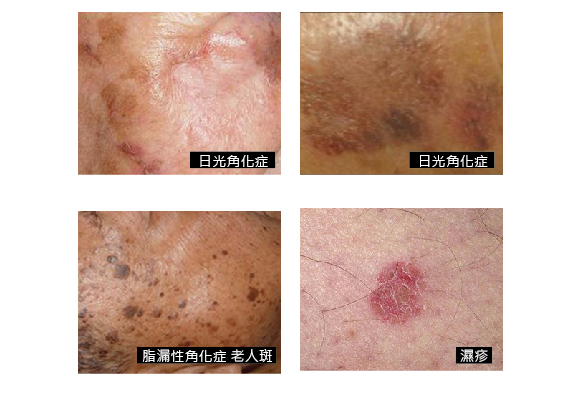
These patches may contain red, brown, or skin-colored mixed areas, and some may exhibit peeling? They may resemble eczema but do not cause itching, and the surrounding areas often show other sunspots or age spots caused by sun exposure?
If you experience the above symptoms, you may have Actinic Keratosis!!
Actinic Keratosis is a form of squamous cell carcinoma in situ, a precursor to the development of skin squamous cell carcinoma, primarily caused by long-term sun exposure.
Generally, patients with Actinic Keratosis will have rough skin surfaces with peeling, presenting as patches or papules. The color is typically red, brown, or skin-colored and is often mistaken for age spots (seborrheic keratosis) or eczema, but without itching. The size of the lesions varies, ranging from less than 1 cm to over 2 cm, and is commonly found in sun-exposed areas such as the face, head, neck, hands, and chest. The incidence of Actinic Keratosis is quite high, especially among Caucasians, elderly individuals, and those frequently exposed to sunlight, such as farmers and workers.
In terms of treatment, there are various methods for Actinic Keratosis depending on the patient's condition, such as topical creams, photodynamic therapy, cryotherapy with liquid nitrogen, curettage, electrosurgery, dermabrasion, laser treatment, and surgical excision. However, surgical excision has gradually become less common in recent years. Photodynamic therapy, electrosurgery, laser, and cryotherapy are less favored due to their inconvenience, potential skin damage, and pain. As a result, topical creams, which are more convenient, have increasingly replaced other treatment methods. While some existing creams may cause side effects like inflammation and ulceration, the cosmetic and functional outcomes after treatment are among the best compared to other therapies, making them the mainstream treatment for Actinic Keratosis. In prevention, exposure to sunlight or ultraviolet rays should be minimized, such as by using sunscreen or protective clothing.
SR-T100 Gel New Drug Development for Treating Skin Squamous Cell Carcinoma in Situ (Actinic Keratosis)
The company has completed Phase III clinical trials of SR-T100 Gel for treating skin squamous cell carcinoma in situ (Actinic Keratosis). The results, as reported in the 2023 Annual Business Report, show a complete cure rate (complete response) of 65.63% for lesions smaller than 1 cm, and a complete cure rate (complete response) of 45.5% for lesions larger than 1 cm. In comparison to other clinical ointments in the same field, SR-T100 Gel has the least side effects. These results have been published in the Journal of Dermatological Science, 90 (3): 295-302, 2018 (Efficacy and safety of topical SR-T100 gel in treating actinic keratosis in Taiwan: A Phase III randomized double-blind vehicle-controlled parallel trial). This paper was selected by the journal's editor as the "Editor’s Choice" classic of the year.